
The Arch-Enemy of Quality in Plastic Film Production: Static Electricity (And How to Eliminate It)
In high-speed plastic film production, invisible forces often cause the most visible damage to your bottom line. While operators may treat static electricity as a minor nuisance, seasoned production managers recognize it as the "silent killer" of quality.
On modern high-speed lines, uncontrolled static is rarely just about a spark; it is the root cause of contaminated rolls, dangerous operator shocks, and costly unscheduled downtime.
Here is the physics behind the problem and why traditional "passive" solutions are no longer enough.
The Physics: The "Capacitor Effect"
On a microscopic level, your production line is a battlefield of electrons. As plastic film travels over idler rolls or passes through nip rollers, triboelectric charging occurs—electrons are stripped from one surface and deposited on another.On high-speed lines, this happens thousands of times per minute. Because plastic is an insulator, these charges cannot flow to the ground naturally. Instead, they accumulate.
The real danger arises at the winder. As the film is wound, layers of charged material stack on top of each other. This creates a massive "Capacitor Effect," capable of storing typically 20,000 to 40,000 volts.
The Cost of Static
Ignoring these physics leads to three expensive outcomes:- 1.Toz Çekimi:
- 2.Operator Safety:
- 3.Process Defects:
Why Passive Bars Fail
Many manufacturers still rely on passive brushes or basic AC eliminators. The problem? They are blind.Passive bars emit ions constantly, regardless of the actual static load. They cannot adapt to the fluctuating speeds or the varying distance of a winding roll. As the roll diameter grows, the distance from the bar changes, rendering fixed-range passive bars ineffective.
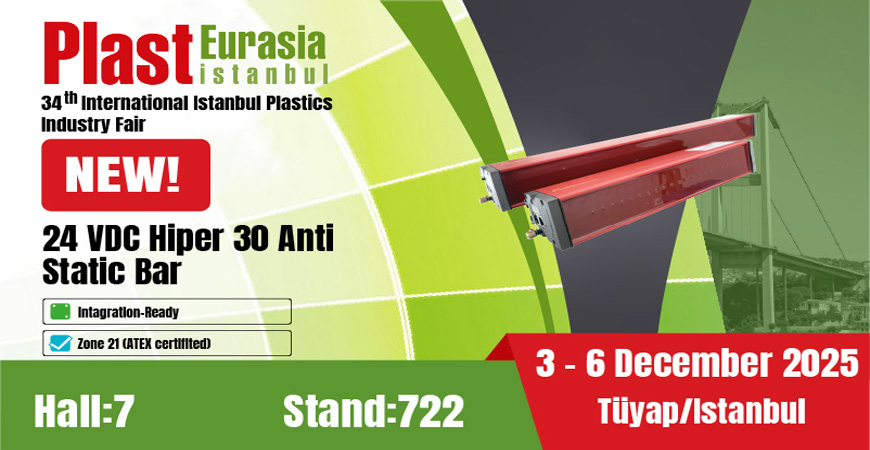
The Solution: 24 VDC Hiper 30 Anti-Static Bar
The Hiper 30 represents a paradigm shift from "passive" to "intelligent" control. It is a closed-loop system engineered specifically for the demanding physics of film extrusion, printing, and packaging.Key Technical Advantages:
Stop letting invisible charges create visible losses.
Our experts will be at Hall 7, Booth 722 to provide a free, no-obligation consultation on your specific application.
SHARE:
CATEGORIES
Populer Tags
Our Youtube Channel
